Every mix engineer has faced this scenario: you have balanced the levels, EQd the obvious problem areas, but something still feels off. The track lacks clarity, warmth, and definition. If this sounds familiar, you are dealing with the low mids problem — one of the most common and treatable mixing challenges.
What Are Low Mids?
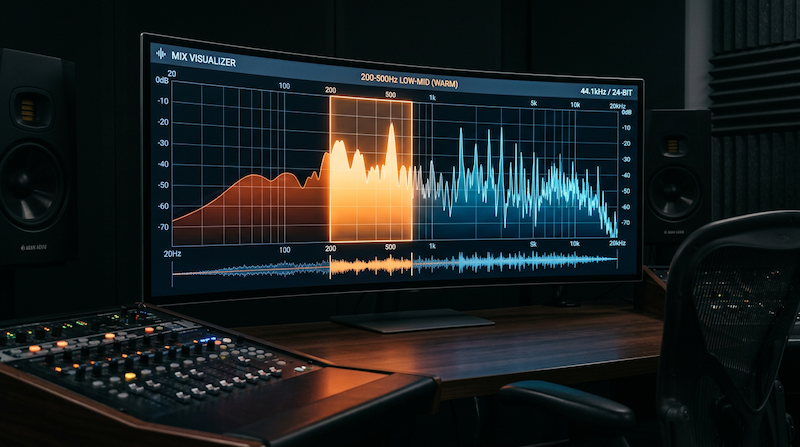
Low mids refer to the frequency range between approximately 200Hz and 500Hz. This band sits between the sub-bass and bass region (below 200Hz) and the upper midrange (above 500Hz). The term is not an exact scientific definition but rather a practical one that mix engineers use to describe a specific area of the frequency spectrum where problems tend to accumulate.
Why Low Mids Tend to Stick Out
Several factors contribute to low mid buildup in a mix:
- Instrument accumulation: Guitars, keyboards, and certain drum elements all occupy this frequency range, creating natural competition.
- Room and microphone proximity: When sound sources are recorded in treated or untreated rooms, low mid energy gets captured disproportionately, especially with close microphone placement.
- Over-EQing the low end: Boosting bass or low mids to add warmth often backfires, creating mud instead of fullness.
- Arrangement density: Dense arrangements with many instruments fighting for space in the low mids will always sound cluttered.
How to Identify Low Mids Problems
Before you can fix low mids, you need to hear them clearly:
- Use references: Compare your mix to professionally mixed commercial tracks. Pay attention to how much space the low mids occupy in the reference.
- Spectrum analysis: Tools like HoRNet Freqs or built-in analyzers show you exactly where energy is concentrated in the low mid band.
- Sweep test: Apply a narrow boost on your parametric EQ and sweep through 200Hz–500Hz. You will immediately hear which frequencies stick out most.
- Solo and listen: Isolate individual tracks and make a broad EQ cut around 300Hz. Notice how much of that muddy build-up was coming from a single instrument.
Techniques to Reduce Low Mid Buildup
Once you have identified the problem areas, these techniques will help you clean up the low mids:
- Parametric EQ with a narrow Q: Target specific problem frequencies within the 200–500Hz band. A moderate cut of 2–4dB with a Q of 1.5–3 can dramatically clean up the mix without making it thin.
- High-pass filtering: Apply high-pass filters to guitars, keyboards, and synths that do not need low mid content. This removes unnecessary energy before it builds up.
- Subtractive EQ: Always use subtractive EQ before additive EQ. Cutting problem frequencies first makes any subsequent boosts more effective and natural sounding.
- Notching: Use narrow notches to surgically remove resonance peaks in the low mid band rather than broad cuts that might affect neighboring frequencies.
- Dynamic EQ: Dynamic equalizers react only when a frequency exceeds a certain threshold. This is particularly useful for managing low mids that only become problematic during louder passages.
Practical Tips for Cleaner Mixes
- Less is more: If multiple instruments are occupying the same low mid space, consider removing or reducing one rather than EQing them all.
- Mid-side EQ: Use mid-side processing to address mono information in the low mids without affecting stereo content.
- Check in mono: Low mid problems become much more apparent when you sum to mono. If your mix cleans up noticeably when switched to mono, you likely have a low mid buildup issue.
- Trust your ears, not just your eyes: While analyzers help, trained ears will catch low mid problems that visual tools miss.
- Take breaks: Listening fatigue makes low mids harder to detect. Step away and return with fresh ears.
HoRNet Plugins for Low Mid Control
Equipping yourself with the right tools makes managing low mids significantly more manageable. HoRNet TotalEQ MK2 is a parametric equalizer that provides surgical precision for targeting problem frequencies in the low mid range. Its intuitive interface makes it easy to identify and reduce accumulated energy without affecting the rest of the spectrum.
For managing sub-frequencies and low-end content that tends to cloud the mix, HoRNet ElliptiQ offers specialized tools for removing unwanted frequencies with precision, helping you achieve a cleaner overall tone.
Understanding and managing low mids is not about cutting everything in the 200–500Hz range — it is about developing the discipline to identify what is actually contributing to the problem and treating it at the source. A clean mix is not built by adding more, but by knowing what to remove.