
Explore how HoRNet Online Mastering uses adaptive DSP, mastering styles and level-matched listening to help musicians compare results.
Mastering decisions are easy to confuse with a single loudness number. In practice, the balance between tone, dynamics and level changes from song to song. When we built HoRNet Online Mastering, we wanted to offer a practical way to explore different processing choices without pretending there is one correct master for every mix.
The service uses adaptive digital signal processing: it analyzes the audio and applies processing based on the material and the chosen style. It is not a human mastering engineer, and we do not describe this processing as machine-learning AI. The musician still has to listen and decide which result serves the song.
Online mastering takes a finished mix, analyzes it and creates a processed version intended for distribution or listening. Depending on the system and style, the chain can adjust tonal balance, dynamics, stereo presentation and peak level. These decisions interact: more limiting, for example, may make a track louder while changing its punch and perceived tone.
A master cannot reliably repair every mix problem. A vocal that is too quiet, a clipped recording or a harsh instrument may need attention in the session. If the result does not sound right, returning to the mix can be more useful than asking a final processor to fix it.
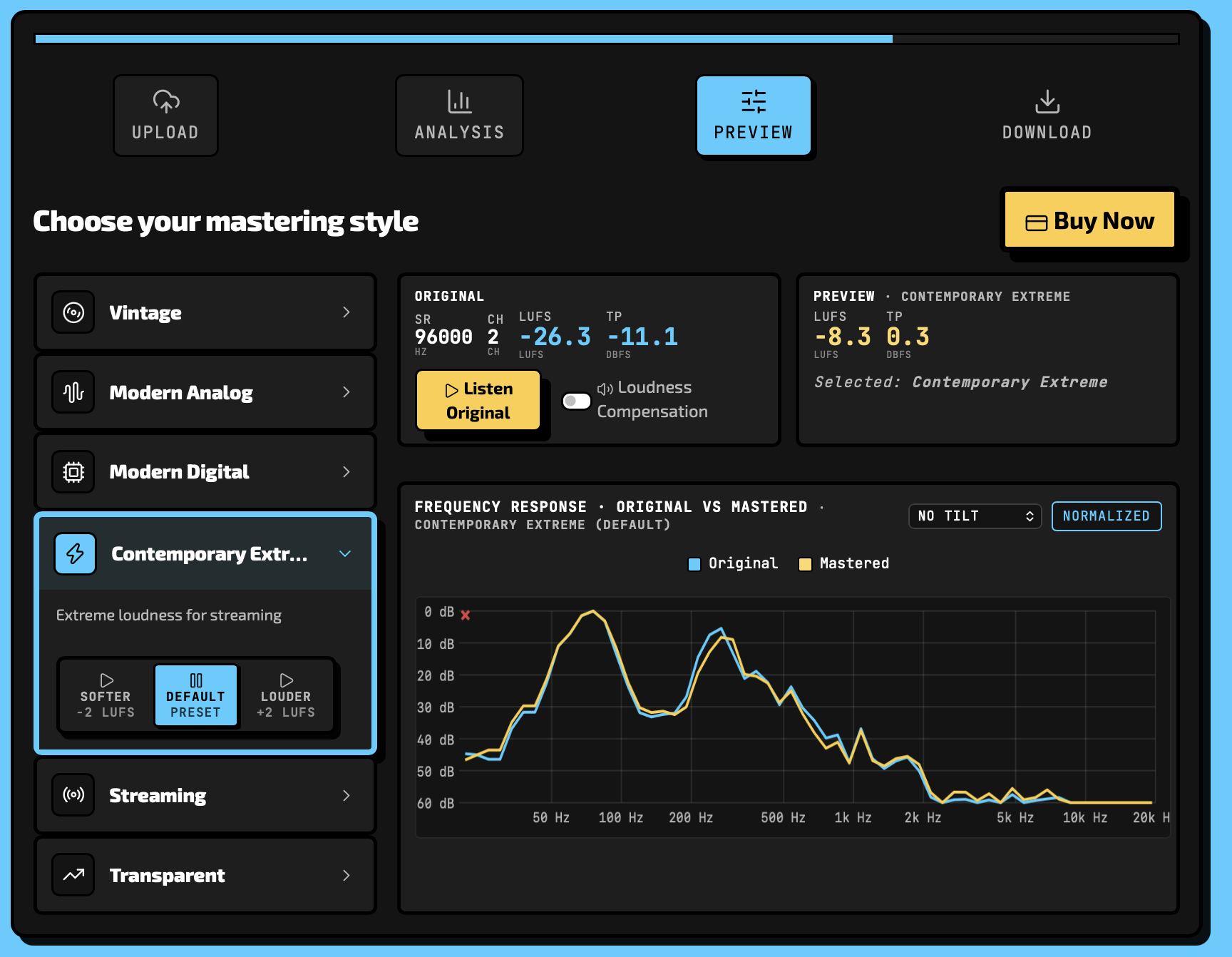
The HoRNet workflow accepts a WAV file, analyzes it and offers previews of different mastering styles. You can compare the processed result with the original, select a style and then proceed to the full-track result. The previews are an audition, not proof that every section of the complete track will respond identically.
Our version 2 offers six styles, ranging from a lighter Transparent option to more assertive choices, as well as an original reference. The names suggest directions, not genre rules: a rock track does not automatically need Vintage, and an electronic track does not automatically need the loudest option. Listen to the music rather than choosing from the label alone.
At a high level, the processor combines analysis with signal-processing stages. Depending on the selected style, these can include equalization, dynamics processing, saturation, stereo processing and limiting. The version 2 architecture draws on technology used in HoRNet plugins, including a three-band dynamics stage and an automatic width component in selected processing paths.
The design question is how much to change and when. A multiband stage can respond differently across frequency ranges, but that control also affects the relationship between them. A limiter can manage peaks, but pushing it harder may alter transients. These are trade-offs, not automatic improvements; the best result depends on the source and the listener’s goal.
Louder audio often sounds more impressive at first. Comparing at similar perceived loudness helps reveal whether a master actually improves the tonal balance, punch or clarity. Our interface includes loudness compensation and displays information about the original and preview; the numbers and spectrum can help you investigate, but they do not replace listening.
Listen beyond the loudest chorus. Check quiet sections, bass, sibilance, cymbals and the space around the vocal. Use familiar headphones or speakers and take a break between comparisons. A spectrum display shows energy over frequency; it cannot tell you whether the emotional balance of the song is right.
Our Streaming style has a nominal loudness target, but streaming services apply their own normalization policies and these can change. A target such as −14 LUFS is not a universal requirement, and matching a number does not guarantee a better master. Dynamics, true peaks and the sound of the mix matter as well.
Different loudness choices can be useful for different releases. More level is not automatically better: compare the effect on the music and leave room for the transients and tonal character you want to keep.
Our goal is to make several processing directions accessible and let the artist choose by ear. Automated processing can be useful for an independent release, a demo or a quick comparison, but it does not provide the conversation, revisions and detailed judgment of a dedicated mastering engineer.
If you want to hear what the approach does to your own mix, explore HoRNet Online Mastering and compare the available previews with the original at a similar level.